Showing posts with label Indonesia. Show all posts

Saturday, 13 April 2019

A magnificent location on planet earth


A change of pace today as I would very much like to share a story of a beautiful location on this planet. Mount Ijen towering over tropical rain forests adorned by layered or terraced rice paddies forming giant steps through the foot hills of this magical spot. A change of pace.

The Ijen volcano complex is a group of composite volcanoes located on the border between Banyuwangi Regency and Bondowoso Regency of East Java, Indonesia.


It is inside a larger caldera Ijen, which is about 20 kilometres wide. The Gunung Merapi stratovolcano is the highest point of that complex. The name "Gunung Merapi" means "mountain of fire" in the Indonesian language (api being "fire"); Mount Merapi in central Java and Marapiin Sumatra have the same etymology.

West of Gunung Merapi is the Ijen volcano, which has a one-kilometre-wide turquoise-coloured acidic crater lake. The lake is the site of a labour-intensive sulfur mining operation, in which sulfur-laden baskets are carried by hand from the crater floor. The work is paid well considering the cost of living in the area, but is very onerous. Workers earn around Rp 50,000–75,000 ($5.50–$8.30) per day and once out of the crater, still need to carry their loads of sulfur chunks about three kilometers to the nearby Paltuding Valley to get paid.

Many other post-caldera cones and craters are located within the caldera or along its rim. The largest concentration of post-caldera cones run east-west across the southern side of the caldera. The active crater at Kawah Ijen has a diameter of 722 metres (2,369 ft) and a surface area of 0.41 square kilometres (0.16 sq mi). It is 200 metres (660 ft) deep and has a volume of 36 cubic hectometres (29,000 acre ft).

The lake is recognised as the largest highly acidic crater lake in the world.[1] It is also a source for the river Banyupahit, resulting in highly acidic and metal-enriched river water which has a significant detrimental effect on the downstream river ecosystem.[5] On July 14–15, 2008, explorer George Kourounis took a small rubber boat out onto the acid lake to measure its acidity. The pH of the water in the lake's edges was measured to be 0.5 and in the middle of the lake 0.13 due to high sulfuric acid concentration.

Blue fire crater

Since National Geographic mentioned the electric-blue flame of Ijen, tourist numbers increased.[7] The phenomenon has occurred for a long time, but beforehand there was no midnight hiking. A two-hour hike is required to reach the rim of the crater, followed by a 45-minute hike down to the bank of the crater. The blue fire is ignited sulfuric gas, which emerges from cracks at temperatures up to 600 °C (1,112 °F).

The flames can be up to five meters (16 feet) high; some of the gas condenses to liquid and is still ignited. It is the largest blue flame area in the world and local people refer to it as 'Blue Fire' 


Sulfur mining at Ijen

An active vent at the edge of the lake is a source of elemental sulfur, and supports a mining operation. Escaping volcanic gases are channelled through a network of ceramic pipes, resulting in condensation of molten sulfur.[10]
The sulfur, which is deep red in colour when molten, pours slowly from the ends of these pipes and pools on the ground, turning bright yellow as it cools. The miners break the cooled material into large pieces and carry it away in baskets. Miners carry loads ranging from 75 to 90 kilograms (165 to 198 lb), up 300 metres (980 ft) to the crater rim, with a gradient of 45 to 60 degrees and then 3 kilometres (1.9 mi) down the mountain for weighing. Most miners make this journey twice a day.

A nearby sulfur refinery pays the miners by the weight of sulfur transported; as of September 2010, the typical daily earnings were equivalent to approximately $13 US. The miners often receive insufficient protection while working around the volcano and complain of numerous respiratory afflictions. There are 200 miners, who extract 14 tons per day – about 20% of the continuous daily deposit.

Ijen and its sulfur mining was featured in the 1991 IMAX film Ring of Fire, and as a topic on the 5th episode of the BBC television documentary Human Planet.

In the documentary film War Photographer, journalist James Nachtwey visits Ijen and struggles with noxious fumes while trying to photograph workers. Michael Glawogger's film Workingman's Death is about sulfur workers.


A change of pace today as I would very much like to share a story of a beautiful location on this planet. Mount Ijen towering over tropical rain forests adorned by layered or terraced rice paddies forming giant steps through the foot hills of this magical spot. A change of pace.

The Ijen volcano complex is a group of composite volcanoes located on the border between Banyuwangi Regency and Bondowoso Regency of East Java, Indonesia.


It is inside a larger caldera Ijen, which is about 20 kilometres wide. The Gunung Merapi stratovolcano is the highest point of that complex. The name "Gunung Merapi" means "mountain of fire" in the Indonesian language (api being "fire"); Mount Merapi in central Java and Marapiin Sumatra have the same etymology.

West of Gunung Merapi is the Ijen volcano, which has a one-kilometre-wide turquoise-coloured acidic crater lake. The lake is the site of a labour-intensive sulfur mining operation, in which sulfur-laden baskets are carried by hand from the crater floor. The work is paid well considering the cost of living in the area, but is very onerous. Workers earn around Rp 50,000–75,000 ($5.50–$8.30) per day and once out of the crater, still need to carry their loads of sulfur chunks about three kilometers to the nearby Paltuding Valley to get paid.

Many other post-caldera cones and craters are located within the caldera or along its rim. The largest concentration of post-caldera cones run east-west across the southern side of the caldera. The active crater at Kawah Ijen has a diameter of 722 metres (2,369 ft) and a surface area of 0.41 square kilometres (0.16 sq mi). It is 200 metres (660 ft) deep and has a volume of 36 cubic hectometres (29,000 acre ft).

The lake is recognised as the largest highly acidic crater lake in the world.[1] It is also a source for the river Banyupahit, resulting in highly acidic and metal-enriched river water which has a significant detrimental effect on the downstream river ecosystem.[5] On July 14–15, 2008, explorer George Kourounis took a small rubber boat out onto the acid lake to measure its acidity. The pH of the water in the lake's edges was measured to be 0.5 and in the middle of the lake 0.13 due to high sulfuric acid concentration.

Blue fire crater

Since National Geographic mentioned the electric-blue flame of Ijen, tourist numbers increased.[7] The phenomenon has occurred for a long time, but beforehand there was no midnight hiking. A two-hour hike is required to reach the rim of the crater, followed by a 45-minute hike down to the bank of the crater. The blue fire is ignited sulfuric gas, which emerges from cracks at temperatures up to 600 °C (1,112 °F).

The flames can be up to five meters (16 feet) high; some of the gas condenses to liquid and is still ignited. It is the largest blue flame area in the world and local people refer to it as 'Blue Fire' 


Sulfur mining at Ijen

An active vent at the edge of the lake is a source of elemental sulfur, and supports a mining operation. Escaping volcanic gases are channelled through a network of ceramic pipes, resulting in condensation of molten sulfur.[10]
The sulfur, which is deep red in colour when molten, pours slowly from the ends of these pipes and pools on the ground, turning bright yellow as it cools. The miners break the cooled material into large pieces and carry it away in baskets. Miners carry loads ranging from 75 to 90 kilograms (165 to 198 lb), up 300 metres (980 ft) to the crater rim, with a gradient of 45 to 60 degrees and then 3 kilometres (1.9 mi) down the mountain for weighing. Most miners make this journey twice a day.

A nearby sulfur refinery pays the miners by the weight of sulfur transported; as of September 2010, the typical daily earnings were equivalent to approximately $13 US. The miners often receive insufficient protection while working around the volcano and complain of numerous respiratory afflictions. There are 200 miners, who extract 14 tons per day – about 20% of the continuous daily deposit.

Ijen and its sulfur mining was featured in the 1991 IMAX film Ring of Fire, and as a topic on the 5th episode of the BBC television documentary Human Planet.

In the documentary film War Photographer, journalist James Nachtwey visits Ijen and struggles with noxious fumes while trying to photograph workers. Michael Glawogger's film Workingman's Death is about sulfur workers.


Tuesday, 26 March 2019

Asia's Century A market of 5 Billion people have awoken.


Asian economies are in some way a dichotomy of what we would call in the west Capitalism versus nationalism. I'll explain but first I'll remind myself of a claim that my first boss made back in the days of Addressograph Multigraph my first employer, he said to me “For Communism or Capitalism to survive they both need to be present”.  I never understood the value of that statement until after the wall fell. The balance to Capitalism in the west became greed with ethics and morals largely cast aside. In Asia, you have a form of checks and balance that mirror those two ideologies. Once in discussion with senior Huaweii exec I referred to their communist balance, he quickly let me know that Communism is a past term and that a more modern name should be applied, although he didn't offer an alternative, but his indignation was felt.


In previous notes I have talked about Globalization and how Asia wants no part of this. I should qualify this; Asian economies have benefited from globalization there is no doubt, but they have stopped short of totally opening up.  Perhaps for several reasons in my view, 1. They have been on the losing side of colonization along with the brutal ills that that brought. 2. The currency crisis of 1998, major corporations were saddled with US debt which they struggled to balance. Many if not all did repay suppliers, loans etc. but it cost them their place in the market. There is no better example of this than Indonesia, two destined to be conglomerates one had the incumbent fixed telecom state owned network as its partner the other Nynex out of the US. One operator XL I would say at that time was progressive dynamic and inventive, the other Telkomsel more pragmatic, harnessed by tradition, due to the 98 financial crisis the balanced shifted in favour of Telkomsel. Today Telkomsel are 3 times bigger than their nearest competitor XL, in a country of 260M 1998 was a significant handicap to XL. Globalization was seen as a western benefit, as a result what we have today is savvy ministers who were able to take the advantage of globalization but spin on a sixpence so to speak as the 2008 financial crisis hit the west, opening the door to regionalism a tried and tested system of integrated trade ties established following 1998, save that of the wave activity which has been present for 50 years as referred here in a previous post. CLICK HERE!

The mix of ideologies following savvy economic policies have put this region as the frontrunner by a furlong to be the dominating party of the 21C. 19C was dominated by the British Empire, the 20th by America and the American dream. We now have an Asia dream and it really should not be missed.

That's not to say that Asia doesn't have its issues, for sure it does. But first be mindful; they are aware of the behaviour of the globalization actors, their aggressive push to build and retain superpower status. Their overtures in seeking free trade policy backed up by neo-mercantile policy. 

Asia have to come to terms with the need to rebalance their economies, to move the power base away from family conglomerates. Large parts of a country’s listed stocks are led from family run business. In Korea, they have a term chaebol which refers to family business conglomerate, they make up 50% of the Korean stock market. We all remember I'm sure the peanut issue on a Korean airline leaving New York, these are powerful families and as such are, in the case of Asia generally able to hold direction over a countries fortunes.  For that reason Asian economic ministers look to China as to the way they have handled this issue in order to spread the wealth creating more entrepreneurialism. In Indonesia large family conglomerates control major sectors such as construction, real estate, shipping, commodities trade, banking, and telecoms. The corporate pyramid remains narrow at the top, giving individuals enormous influence over policy. According to McKinsey, family businesses across the region have been growing at more than 20 percent per year over the past decade and using their strong cash positions to invest in joint ventures and new technology that raise the productivity of their home-based workers. Some might call this Confucian capitalism, recognizing the centrality of community, it is as Chinese as the notion of guanxi, or having privileged influence through networks. 


Corruption is a scourge across the world, it has more visibility across Asia only because the money is not flowing into the pockets of the west. In Asia, particularly Indonesia there is an anti corruption unit which has made great strides to reduce this burden, as with China many official have fallen, continuing to fall, they are being jailed by the 100s. Through pragmatism, good leadership and a realization as to the handicap this practise have on future growth prospect. 

Consider: In the west Competition is freely banded around as though it is the domain of western economies. But look at the banking sector. As one executive of a European bank put it, “In the US, American banks face little competition to service wealthy clients. In Europe, both European and American banks compete for the market. And in Asia, European, American, and Asian banks are all competing for wealthy customers. All our margins get squeezed, but at the same time it unlocks trillions of dollars of savings to be profitably invested.”

All of this is fascinating but the facts remain Asia will march forward in this Century. Americanism will give way just as Colonialism gave way. Stop it you can not, participate for sure you can!


Asian economies are in some way a dichotomy of what we would call in the west Capitalism versus nationalism. I'll explain but first I'll remind myself of a claim that my first boss made back in the days of Addressograph Multigraph my first employer, he said to me “For Communism or Capitalism to survive they both need to be present”.  I never understood the value of that statement until after the wall fell. The balance to Capitalism in the west became greed with ethics and morals largely cast aside. In Asia, you have a form of checks and balance that mirror those two ideologies. Once in discussion with senior Huaweii exec I referred to their communist balance, he quickly let me know that Communism is a past term and that a more modern name should be applied, although he didn't offer an alternative, but his indignation was felt.


In previous notes I have talked about Globalization and how Asia wants no part of this. I should qualify this; Asian economies have benefited from globalization there is no doubt, but they have stopped short of totally opening up.  Perhaps for several reasons in my view, 1. They have been on the losing side of colonization along with the brutal ills that that brought. 2. The currency crisis of 1998, major corporations were saddled with US debt which they struggled to balance. Many if not all did repay suppliers, loans etc. but it cost them their place in the market. There is no better example of this than Indonesia, two destined to be conglomerates one had the incumbent fixed telecom state owned network as its partner the other Nynex out of the US. One operator XL I would say at that time was progressive dynamic and inventive, the other Telkomsel more pragmatic, harnessed by tradition, due to the 98 financial crisis the balanced shifted in favour of Telkomsel. Today Telkomsel are 3 times bigger than their nearest competitor XL, in a country of 260M 1998 was a significant handicap to XL. Globalization was seen as a western benefit, as a result what we have today is savvy ministers who were able to take the advantage of globalization but spin on a sixpence so to speak as the 2008 financial crisis hit the west, opening the door to regionalism a tried and tested system of integrated trade ties established following 1998, save that of the wave activity which has been present for 50 years as referred here in a previous post. CLICK HERE!

The mix of ideologies following savvy economic policies have put this region as the frontrunner by a furlong to be the dominating party of the 21C. 19C was dominated by the British Empire, the 20th by America and the American dream. We now have an Asia dream and it really should not be missed.

That's not to say that Asia doesn't have its issues, for sure it does. But first be mindful; they are aware of the behaviour of the globalization actors, their aggressive push to build and retain superpower status. Their overtures in seeking free trade policy backed up by neo-mercantile policy. 

Asia have to come to terms with the need to rebalance their economies, to move the power base away from family conglomerates. Large parts of a country’s listed stocks are led from family run business. In Korea, they have a term chaebol which refers to family business conglomerate, they make up 50% of the Korean stock market. We all remember I'm sure the peanut issue on a Korean airline leaving New York, these are powerful families and as such are, in the case of Asia generally able to hold direction over a countries fortunes.  For that reason Asian economic ministers look to China as to the way they have handled this issue in order to spread the wealth creating more entrepreneurialism. In Indonesia large family conglomerates control major sectors such as construction, real estate, shipping, commodities trade, banking, and telecoms. The corporate pyramid remains narrow at the top, giving individuals enormous influence over policy. According to McKinsey, family businesses across the region have been growing at more than 20 percent per year over the past decade and using their strong cash positions to invest in joint ventures and new technology that raise the productivity of their home-based workers. Some might call this Confucian capitalism, recognizing the centrality of community, it is as Chinese as the notion of guanxi, or having privileged influence through networks. 


Corruption is a scourge across the world, it has more visibility across Asia only because the money is not flowing into the pockets of the west. In Asia, particularly Indonesia there is an anti corruption unit which has made great strides to reduce this burden, as with China many official have fallen, continuing to fall, they are being jailed by the 100s. Through pragmatism, good leadership and a realization as to the handicap this practise have on future growth prospect. 

Consider: In the west Competition is freely banded around as though it is the domain of western economies. But look at the banking sector. As one executive of a European bank put it, “In the US, American banks face little competition to service wealthy clients. In Europe, both European and American banks compete for the market. And in Asia, European, American, and Asian banks are all competing for wealthy customers. All our margins get squeezed, but at the same time it unlocks trillions of dollars of savings to be profitably invested.”

All of this is fascinating but the facts remain Asia will march forward in this Century. Americanism will give way just as Colonialism gave way. Stop it you can not, participate for sure you can!


Monday, 18 March 2019

Indonesia looks to well-being, health and balance for their growth


All around the world we see today a dichotomy between wealth and poverty.  Nowhere is that scarily abject than in the so called third world economies. Historically we have all followed an American devised system of statistical measure, “GDP” Gross Domestic Product. GDP is fine when you all share in the benefit, although arguably when you tour America you could say that GDP as a measure of wealth has failed even in the US, 1 in 8 live in poverty across this great nation.

Asia does however, have a handicap which Indonesia is not immune to. Much of the economy is controlled by family conglomerates, too few of these exist. Therefore, polarizing wealth into too few hands, which of course makes the government job to assist fledgling companies more difficult.


That aside Indonesia have opened the doors to eCommerce, the digital economy as a way to encourage a paradigm shift. To some extent this is wishful thinking but all credit to them they are at the beginning of a sincere initiative.

I have for a long period argued that you can not have a system that polarizes 80% of the world's wealth, and have that system determine well-being when the money is sitting with 20% of the population. The absurdity is more acute as you reach the top 2% or 3%. It is this dichotomy that will, over what is now a short period unwind society. My guess with Brexit, Italian elections, Jaunes Gilet (yellow vest), Trump's America this is all a polite wake up call to the elites in our political class that enough is enough. Whether they are yet listening that's not so obvious.

However, one area, for me a little surprising but most welcome nonetheless is the “World Economic Forum”. Here they have discussed, debated and formed the same conclusions, the system of GDP is archaic and replaced it with an Inclusive Development Index “IDI”. This index considers well-being, life expectancy, unemployment, median income, poverty, inequality, household savings, carbon emissions plus a myriad of other issues that encompasses us all. You could argue whilst our western politicians fiddle as Rome burns, line their pockets, protect their various expense scams other more dynamic areas have embraced this revolutionary index, Indonesia being one such area. 


In Asia, Australia and New Zealand rank highest, followed by South Korea and Israel, which rank in the top twenty. The next tier of emerging Asian countries is making substantial strides in most categories of inclusive development, including Azerbaijan, Malaysia, Kazakhstan, Turkey, Thailand, China, Iran, Vietnam, Indonesia, and the Philippines. We should be mindful that Asia is also home to countries in the bottom tier such as Afghanistan, Pakistan, India, Bangladesh, Cambodia, Laos, and Yemen. The Asia development bank have taken a step further and published their Social Protection Index. “SPI”. This index shows South Asia, Southeast and Central Asia are lacking their Eastern Asia neighbours with their subsistence programmes. But as with the economic wave example Asia will develop together through assisting each other, I have confidence the West could learn from the East when it comes to inclusive growth. Whether, the west is open to rocking the elites’ gravy train the jury is out.

If you look to the World Economic Forum website there is a PDF file which can be downloaded, this will give more depth to the points reference IDI that I have raised above:

“The Inclusive Development Index (IDI) is an annual assessment of 103 countries’ economic performance that measures how countries perform on eleven dimensions of economic progress in addition to GDP. It has 3 pillars; growth and development; inclusion and; intergenerational equity – sustainable stewardship of natural and financial resources.
The IDI is a project of the World Economic Forum’s System Initiative on the Future of Economic Progress, which aims to inform and enable sustained and inclusive economic progress through deepened public-private cooperation through thought leadership and analysis, strategic dialogue and concrete cooperation, including by accelerating social impact through corporate action.”

Bedtime reading...


All around the world we see today a dichotomy between wealth and poverty.  Nowhere is that scarily abject than in the so called third world economies. Historically we have all followed an American devised system of statistical measure, “GDP” Gross Domestic Product. GDP is fine when you all share in the benefit, although arguably when you tour America you could say that GDP as a measure of wealth has failed even in the US, 1 in 8 live in poverty across this great nation.

Asia does however, have a handicap which Indonesia is not immune to. Much of the economy is controlled by family conglomerates, too few of these exist. Therefore, polarizing wealth into too few hands, which of course makes the government job to assist fledgling companies more difficult.


That aside Indonesia have opened the doors to eCommerce, the digital economy as a way to encourage a paradigm shift. To some extent this is wishful thinking but all credit to them they are at the beginning of a sincere initiative.

I have for a long period argued that you can not have a system that polarizes 80% of the world's wealth, and have that system determine well-being when the money is sitting with 20% of the population. The absurdity is more acute as you reach the top 2% or 3%. It is this dichotomy that will, over what is now a short period unwind society. My guess with Brexit, Italian elections, Jaunes Gilet (yellow vest), Trump's America this is all a polite wake up call to the elites in our political class that enough is enough. Whether they are yet listening that's not so obvious.

However, one area, for me a little surprising but most welcome nonetheless is the “World Economic Forum”. Here they have discussed, debated and formed the same conclusions, the system of GDP is archaic and replaced it with an Inclusive Development Index “IDI”. This index considers well-being, life expectancy, unemployment, median income, poverty, inequality, household savings, carbon emissions plus a myriad of other issues that encompasses us all. You could argue whilst our western politicians fiddle as Rome burns, line their pockets, protect their various expense scams other more dynamic areas have embraced this revolutionary index, Indonesia being one such area. 


In Asia, Australia and New Zealand rank highest, followed by South Korea and Israel, which rank in the top twenty. The next tier of emerging Asian countries is making substantial strides in most categories of inclusive development, including Azerbaijan, Malaysia, Kazakhstan, Turkey, Thailand, China, Iran, Vietnam, Indonesia, and the Philippines. We should be mindful that Asia is also home to countries in the bottom tier such as Afghanistan, Pakistan, India, Bangladesh, Cambodia, Laos, and Yemen. The Asia development bank have taken a step further and published their Social Protection Index. “SPI”. This index shows South Asia, Southeast and Central Asia are lacking their Eastern Asia neighbours with their subsistence programmes. But as with the economic wave example Asia will develop together through assisting each other, I have confidence the West could learn from the East when it comes to inclusive growth. Whether, the west is open to rocking the elites’ gravy train the jury is out.

If you look to the World Economic Forum website there is a PDF file which can be downloaded, this will give more depth to the points reference IDI that I have raised above:

“The Inclusive Development Index (IDI) is an annual assessment of 103 countries’ economic performance that measures how countries perform on eleven dimensions of economic progress in addition to GDP. It has 3 pillars; growth and development; inclusion and; intergenerational equity – sustainable stewardship of natural and financial resources.
The IDI is a project of the World Economic Forum’s System Initiative on the Future of Economic Progress, which aims to inform and enable sustained and inclusive economic progress through deepened public-private cooperation through thought leadership and analysis, strategic dialogue and concrete cooperation, including by accelerating social impact through corporate action.”

Bedtime reading...


Friday, 15 March 2019

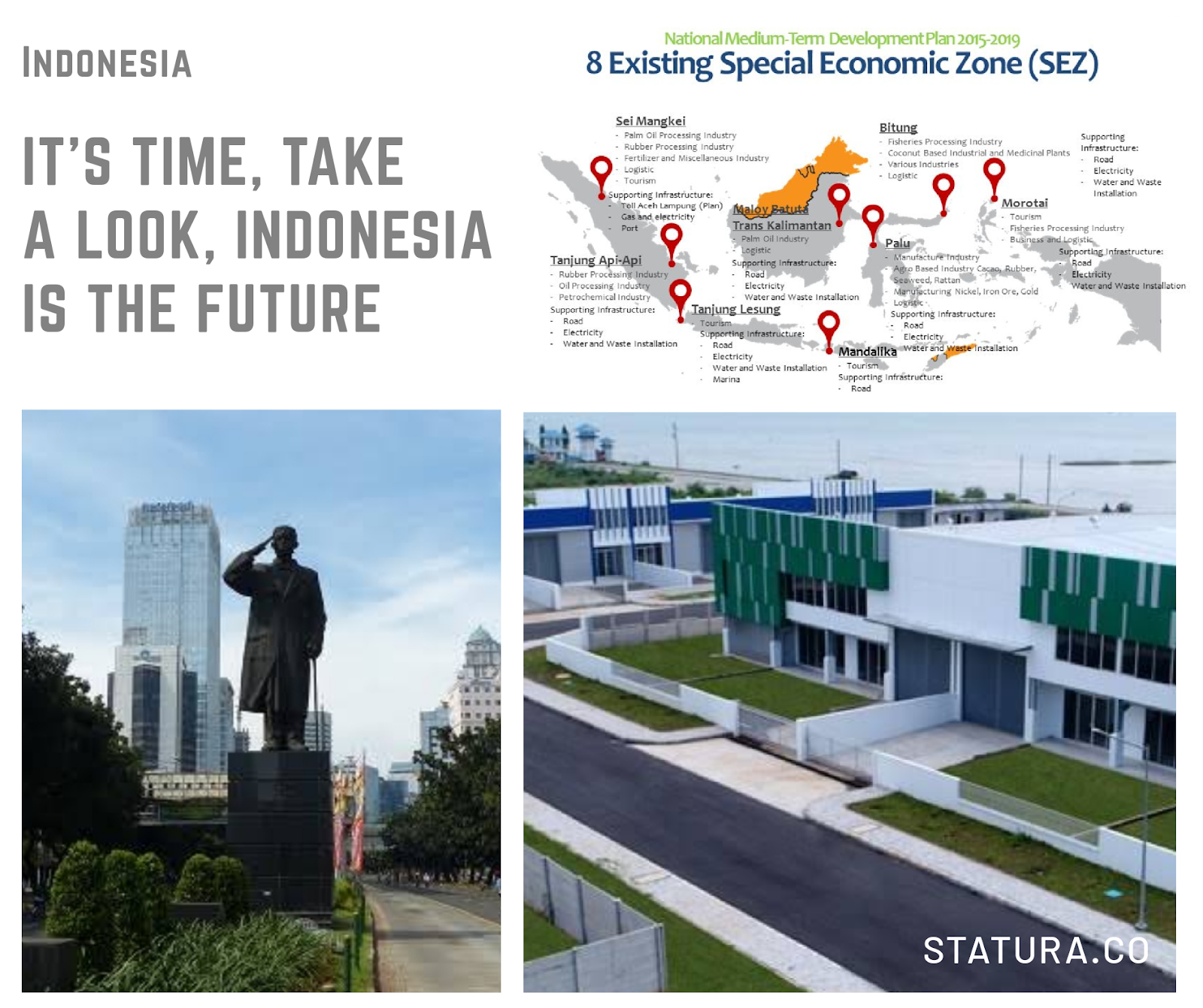
Industrial parks, indonesia is open for business


The advances that South East Asia have made demonstrate the progressive nature of this great region. It was from SE Asia where, what is termed a prehistoric civilizations dating back to 6000 BC, first developed the ability to organize agriculture, cultivated farming growing cereal. Prior to this point they were predominantly hunter-gatherers, going in search of their food source, their food came only from the wild. It took Japan until the Jõmon period to adopt such techniques, circa 5000 BC. China came 1000 years later. You could even argue that through their achievements that SE Asia heralded in the Bronze Age. Tools much needed to sustain their advance culture.

Throughout Asia, you see evidence as to how the western societies have benefited from Asian innovation. Circa 3500 BC ancient cities emerged, wide streets, bathing platforms, drainage and reservoirs.  These were located in the Indus valley, now known as Pakistan.


Babylonians developed an alphabet which was adopted by the Greeks. Egypt relied on Babylon for trade, diplomacy the selling of cedar wood, olive oil and resins for mummification.

Asia has not emerged it has returned. Trading networks have functioned since the 8C BC, between Greece, Persia and India. India had established trading routes through South East Asia and China. China had at this time consolidated its power by possessing the Xia, Shang, and Zhou dynasties.  They had established trade routes to Southern Siberia bringing wealth to the nomadic peoples residing there.  China also, had routes to Bactria, trading freely. Bactria, an area north of the Hindu Kush, straddling parts of Afghanistan, Tajikistan, Pakistan and Uzbekistan. As a point of interest, it is thought that they were using single axle chariots 2000 years BC.

Greeks, by the 1ST Century BC had a vast maritime fleet.  One hundred and twenty ships per year sailed through the red sea, using monsoon winds in order to reach the ports of India. India through its own trade routes into SE Asia provided a staging post giving access to a wealth of spices, jade, beads etc.

Moving forward to today, it's fair to say that much of today's government policy comes from the many large family run corporations that have over years dominated the trade of this region. Asia is not short of family run conglomerates.  But, Indonesia’s government  are playing a key role in re-distributing wealth. Technology have opened the way for this process to start.

China's investment in sea routes East to West, their investment in the Suez Canal along with their influence over Israel. Israel have commissioned a rail network linking the Red sea with the Mediterranean sea forming an important part of the Belt and Road system. Indonesia is poised to benefit from this route looking to boost trade with Mediterranean countries.


Asian countries are increasingly looking to each other for their defence, sustainability, guidance and tolerance, they pull together. To some extent they have become immune to the western attempts at “globalization”, in 1998, the Asian crisis swept through the countries of SE Asia, they are mindful that it was an Asian contagion. In 2018, they see the west as still mired by the  financial collapse of 2008, yet Asian economies are enjoying bumper growth. A point of fact, all the major growth countries of 2018, they were from Asia.

Asian countries see the US as a facilitator of technology, innovation, but they no longer look to the US for their prosperity nor their defence. They see Trump's America as a wake up call, America can not be relied upon indeed, to do so would be a handicap. The US is now dispensable when it comes to Asia.

Indonesia is also advantaged with a vast population. The government have seen China's growth and have recognised, that China manufacturing is becoming uncompetitive. For instance China daily manufacturing salaries/pay is $30, Indonesia is still at $10.  Factories, Industrial, Science parks are emerging across this vast archipelago.


The advances that South East Asia have made demonstrate the progressive nature of this great region. It was from SE Asia where, what is termed a prehistoric civilizations dating back to 6000 BC, first developed the ability to organize agriculture, cultivated farming growing cereal. Prior to this point they were predominantly hunter-gatherers, going in search of their food source, their food came only from the wild. It took Japan until the Jõmon period to adopt such techniques, circa 5000 BC. China came 1000 years later. You could even argue that through their achievements that SE Asia heralded in the Bronze Age. Tools much needed to sustain their advance culture.

Throughout Asia, you see evidence as to how the western societies have benefited from Asian innovation. Circa 3500 BC ancient cities emerged, wide streets, bathing platforms, drainage and reservoirs.  These were located in the Indus valley, now known as Pakistan.


Babylonians developed an alphabet which was adopted by the Greeks. Egypt relied on Babylon for trade, diplomacy the selling of cedar wood, olive oil and resins for mummification.

Asia has not emerged it has returned. Trading networks have functioned since the 8C BC, between Greece, Persia and India. India had established trading routes through South East Asia and China. China had at this time consolidated its power by possessing the Xia, Shang, and Zhou dynasties.  They had established trade routes to Southern Siberia bringing wealth to the nomadic peoples residing there.  China also, had routes to Bactria, trading freely. Bactria, an area north of the Hindu Kush, straddling parts of Afghanistan, Tajikistan, Pakistan and Uzbekistan. As a point of interest, it is thought that they were using single axle chariots 2000 years BC.

Greeks, by the 1ST Century BC had a vast maritime fleet.  One hundred and twenty ships per year sailed through the red sea, using monsoon winds in order to reach the ports of India. India through its own trade routes into SE Asia provided a staging post giving access to a wealth of spices, jade, beads etc.

Moving forward to today, it's fair to say that much of today's government policy comes from the many large family run corporations that have over years dominated the trade of this region. Asia is not short of family run conglomerates.  But, Indonesia’s government  are playing a key role in re-distributing wealth. Technology have opened the way for this process to start.

China's investment in sea routes East to West, their investment in the Suez Canal along with their influence over Israel. Israel have commissioned a rail network linking the Red sea with the Mediterranean sea forming an important part of the Belt and Road system. Indonesia is poised to benefit from this route looking to boost trade with Mediterranean countries.


Asian countries are increasingly looking to each other for their defence, sustainability, guidance and tolerance, they pull together. To some extent they have become immune to the western attempts at “globalization”, in 1998, the Asian crisis swept through the countries of SE Asia, they are mindful that it was an Asian contagion. In 2018, they see the west as still mired by the  financial collapse of 2008, yet Asian economies are enjoying bumper growth. A point of fact, all the major growth countries of 2018, they were from Asia.

Asian countries see the US as a facilitator of technology, innovation, but they no longer look to the US for their prosperity nor their defence. They see Trump's America as a wake up call, America can not be relied upon indeed, to do so would be a handicap. The US is now dispensable when it comes to Asia.

Indonesia is also advantaged with a vast population. The government have seen China's growth and have recognised, that China manufacturing is becoming uncompetitive. For instance China daily manufacturing salaries/pay is $30, Indonesia is still at $10.  Factories, Industrial, Science parks are emerging across this vast archipelago.


Wednesday, 13 March 2019

Indonesia The Opportunity The Way!


How does history look from an Asian perspective.  For us Europeans and to a lesser extent America. History is about the birth of civilization, the cradle of civilization yet when we look at history we look through our western eyes, we look to the Greeks their philosophers, the Romans their armies and structure. Our foray into Asia really only came of age in the 13C, although many Europeans were living in China, mostly as missionaries or traders.

Genghis Khan can be attributed to birth of modern China. He took his armies throughout the regions sweeping many dynasties into one country, what is now modern day China. Bringing rule to the many regions that surrounded the old imperial kingdom. So successful his empire he went on to encompass much of Muslim enclaves of the Middle East.  With his Mongol Army he reached to the gates of Vienna Austria. Genghis Khan was perhaps the greatest military strategist that ever existed. But, he also had great commercial insight as it was him that devised and implemented the “Silk Road”, which of course is the founding father to President Xi “Belt and Road Initiative” BRI.


Next came the Middle Ages, the Copernicus, renaissance, Ottoman era. Copernicus began our understanding of the universe how the sun forms its centre. Then came Napoleon the period of enlightenment. After which came “British Colonialism”, “American Independence”, concluding with two world wars. Of course this can be further defined: Caesar, Cleopatra, the Holy Roman Empire and Black Death, Martin Luther and Louis XIV, the slave trade and Industrial Revolution, the Congress of Vienna and Crimean War, Franklin D. Roosevelt and Josef Stalin. 

But history is much more than this, Mesopotamia and Egypt were dominant much before the Greeks or the Romans.  Asia at this point was already a powerful force, great trading nations were established and operated for many centuries BC. Indeed, it was not until the 4thC BC that Europe through the Greeks opened trade with Asia bringing spices to the tables of Europe.

My point in all of this is that Europe needs to trade with Asia, but, as Asia develops we will find that our colonial past is not viewed through the rose-tinted glasses that our western teachings allow us to remember.  Asia is much more and we must be mindful of this, but not apologetic.

For the benefit of my blog I focus on just one small part, Indonesia. A country so diverse in cultures, languages and religions. If lifted off the map and overlaid on Europe it would stretch from London to Tehran. The unifying language is Bahasa Indonesia, but in reality there are 250 languages each distinct in their own right. The population extends to 260M people. On its own it represents one third of Europe. All of which are upwardly mobile, a significant middle class exists today, within a modern day progressive democracy. Indeed, PWC predict that Indonesia will be the worlds 5th largest economy within the next 10 years. Development projects: New airports, toll roads, power stations, an advanced telecoms network with perhaps the largest mobile operators outside of China,  these are already taking place and supports PWCs projections.


2019 is an election year, this will take place in April. It is widely predicted that the incumbent Jokowi Widodo will retain the presidency.  But, Investors usually adopt a wait-and-see approach ahead of Indonesia’s presidential elections. For this reason, the Indonesian government will continue to rely on domestic investment and household spending to drive the country's economy in 2019. The Ministry of Social Affairs has allocated a social assistance budget of 381 trillion IDR in 2019, up 33% from that of the previous year of 287 trillion IDR to boost consumer spending in order to keep this crucial aspect of the economy on a safe track.

Statura provides a network of skilled local qualified business folk, most have been associated with me directly or through Statura since the mid 90s.  We have weathered revolutions, currency upheavals and participated in this dynamic transition to what is now a modern honest democracy.


How does history look from an Asian perspective.  For us Europeans and to a lesser extent America. History is about the birth of civilization, the cradle of civilization yet when we look at history we look through our western eyes, we look to the Greeks their philosophers, the Romans their armies and structure. Our foray into Asia really only came of age in the 13C, although many Europeans were living in China, mostly as missionaries or traders.

Genghis Khan can be attributed to birth of modern China. He took his armies throughout the regions sweeping many dynasties into one country, what is now modern day China. Bringing rule to the many regions that surrounded the old imperial kingdom. So successful his empire he went on to encompass much of Muslim enclaves of the Middle East.  With his Mongol Army he reached to the gates of Vienna Austria. Genghis Khan was perhaps the greatest military strategist that ever existed. But, he also had great commercial insight as it was him that devised and implemented the “Silk Road”, which of course is the founding father to President Xi “Belt and Road Initiative” BRI.


Next came the Middle Ages, the Copernicus, renaissance, Ottoman era. Copernicus began our understanding of the universe how the sun forms its centre. Then came Napoleon the period of enlightenment. After which came “British Colonialism”, “American Independence”, concluding with two world wars. Of course this can be further defined: Caesar, Cleopatra, the Holy Roman Empire and Black Death, Martin Luther and Louis XIV, the slave trade and Industrial Revolution, the Congress of Vienna and Crimean War, Franklin D. Roosevelt and Josef Stalin. 

But history is much more than this, Mesopotamia and Egypt were dominant much before the Greeks or the Romans.  Asia at this point was already a powerful force, great trading nations were established and operated for many centuries BC. Indeed, it was not until the 4thC BC that Europe through the Greeks opened trade with Asia bringing spices to the tables of Europe.

My point in all of this is that Europe needs to trade with Asia, but, as Asia develops we will find that our colonial past is not viewed through the rose-tinted glasses that our western teachings allow us to remember.  Asia is much more and we must be mindful of this, but not apologetic.

For the benefit of my blog I focus on just one small part, Indonesia. A country so diverse in cultures, languages and religions. If lifted off the map and overlaid on Europe it would stretch from London to Tehran. The unifying language is Bahasa Indonesia, but in reality there are 250 languages each distinct in their own right. The population extends to 260M people. On its own it represents one third of Europe. All of which are upwardly mobile, a significant middle class exists today, within a modern day progressive democracy. Indeed, PWC predict that Indonesia will be the worlds 5th largest economy within the next 10 years. Development projects: New airports, toll roads, power stations, an advanced telecoms network with perhaps the largest mobile operators outside of China,  these are already taking place and supports PWCs projections.


2019 is an election year, this will take place in April. It is widely predicted that the incumbent Jokowi Widodo will retain the presidency.  But, Investors usually adopt a wait-and-see approach ahead of Indonesia’s presidential elections. For this reason, the Indonesian government will continue to rely on domestic investment and household spending to drive the country's economy in 2019. The Ministry of Social Affairs has allocated a social assistance budget of 381 trillion IDR in 2019, up 33% from that of the previous year of 287 trillion IDR to boost consumer spending in order to keep this crucial aspect of the economy on a safe track.

Statura provides a network of skilled local qualified business folk, most have been associated with me directly or through Statura since the mid 90s.  We have weathered revolutions, currency upheavals and participated in this dynamic transition to what is now a modern honest democracy.

Sunday, 24 February 2019

Brexit - Feb 25th Delay really Why? Blair's A Brexiteer


Several headlines captured me this morning. That's my morning as l’m slightly North of Australia.  The one that concerns me the most is of course the possibility of delaying Brexit. Another which is of significance was an article I read on Linkedin. The article referred to the businesses that are struggling due to uncertainty.  They just need that we get on with it and leave, if it's no deal they can plan accordingly.  As I've pointed out in previous papers that I've written, 90% of our manufactured goods go outside of the EU (88% directly out with a further 2% entering the EU and then leaving via Rotterdam), yet we have to apply EU regulation across the board.

The terms that we will trade on need to be clarified and planned accordingly.  The MPs that are frustrating this process are no friend of the British people and should be removed. We are now at a point where a further delay is unacceptable.  With an oncoming recession this could do irretrievable harm to corporate UK.  The EU has been a sick segment of the world for far too long. Their collective growth since 2008 have been poor to say the least, they, the Euro zone have averaged a little over 2% in 9 years. The UK 8.8%, the USA 14.4%. If you show Germany they are at 7.6%, France 4.6%, Greece minus 27%.


Our exports to the EU have underperformed the exports from WTO countries. Businesses need clarity. Are we in are we out? To delay just drops a fog over the British Isles and the United Kingdom.  Soon the remainers will have their way and be able to prove Brexit will have damaged the economy. Yet it's not Brexit that will damage it, it is they! We are where the remainers want us to be! We should have no patience with this.

I also read an article in the Daily Telegraph written by Boris. He refers to the labels that are applied to us Brexiteers. Zealots, Xenophobic, Racist and so on.  That somehow unless you're right wing with fascists tendencies you would want to remain in the EU. Boris makes an excellent point that Tony Blair was a fervent Brexiteer (Although my gut tells me that was him telling us what we wanted to hear in order that he gets his way winning the highest office in the land.  It is also not beyond the realm of being possible that he is angling for Junker's job, but of course we have to remain.  History will go full circle!). But, nonetheless Boris refers to many other lefties that have expressed dis-satisfaction with the EU.


I for one can not be labelled in such terms.  My business is in Asia, it focuses on Indonesia in particular. I stand ready to support Corporate UK to establish a presence in the soon to be 5th largest economy. Who, incidentally trades with the EU on WTO. My wife is a legal and financial expert, and she is Asian. My partners are Asian some are mixed and from many religious beliefs. To label Brexiteers this way is to do the UK an injustice, it is also an insult to our seafaring ancestry.

The facts are clear, regulation is absurd. Tariffs are ridiculous 50% on some dairy products, 30% on others reducing to 18% in some cases.  This is a tax on the people of the UK. It is a tax that benefits Europe and not us Brits!

Leave, and do it on March the 29th at 11pm. Take no nonsense from these vested self interested politician's. A delay is appalling behaviour.


Several headlines captured me this morning. That's my morning as l’m slightly North of Australia.  The one that concerns me the most is of course the possibility of delaying Brexit. Another which is of significance was an article I read on Linkedin. The article referred to the businesses that are struggling due to uncertainty.  They just need that we get on with it and leave, if it's no deal they can plan accordingly.  As I've pointed out in previous papers that I've written, 90% of our manufactured goods go outside of the EU (88% directly out with a further 2% entering the EU and then leaving via Rotterdam), yet we have to apply EU regulation across the board.

The terms that we will trade on need to be clarified and planned accordingly.  The MPs that are frustrating this process are no friend of the British people and should be removed. We are now at a point where a further delay is unacceptable.  With an oncoming recession this could do irretrievable harm to corporate UK.  The EU has been a sick segment of the world for far too long. Their collective growth since 2008 have been poor to say the least, they, the Euro zone have averaged a little over 2% in 9 years. The UK 8.8%, the USA 14.4%. If you show Germany they are at 7.6%, France 4.6%, Greece minus 27%.


Our exports to the EU have underperformed the exports from WTO countries. Businesses need clarity. Are we in are we out? To delay just drops a fog over the British Isles and the United Kingdom.  Soon the remainers will have their way and be able to prove Brexit will have damaged the economy. Yet it's not Brexit that will damage it, it is they! We are where the remainers want us to be! We should have no patience with this.

I also read an article in the Daily Telegraph written by Boris. He refers to the labels that are applied to us Brexiteers. Zealots, Xenophobic, Racist and so on.  That somehow unless you're right wing with fascists tendencies you would want to remain in the EU. Boris makes an excellent point that Tony Blair was a fervent Brexiteer (Although my gut tells me that was him telling us what we wanted to hear in order that he gets his way winning the highest office in the land.  It is also not beyond the realm of being possible that he is angling for Junker's job, but of course we have to remain.  History will go full circle!). But, nonetheless Boris refers to many other lefties that have expressed dis-satisfaction with the EU.


I for one can not be labelled in such terms.  My business is in Asia, it focuses on Indonesia in particular. I stand ready to support Corporate UK to establish a presence in the soon to be 5th largest economy. Who, incidentally trades with the EU on WTO. My wife is a legal and financial expert, and she is Asian. My partners are Asian some are mixed and from many religious beliefs. To label Brexiteers this way is to do the UK an injustice, it is also an insult to our seafaring ancestry.

The facts are clear, regulation is absurd. Tariffs are ridiculous 50% on some dairy products, 30% on others reducing to 18% in some cases.  This is a tax on the people of the UK. It is a tax that benefits Europe and not us Brits!

Leave, and do it on March the 29th at 11pm. Take no nonsense from these vested self interested politician's. A delay is appalling behaviour.


Saturday, 23 February 2019

Indonesia Launches its first MRT


It's finally arrived; Jakarta has commissioned its first Mass Transport system, the first such system in Indonesia. A project fraught with difficulty, taking longer than expected with development stopping frequently.

The system has been on trial since December, testing all supporting systems, electronic gates as well as the reactions of emergency services should the need arise.  Services will operate from March 12th, 2019.

In the past week the proud authorities invited government officials, ambassadors and journalists to trial the first MRT in Indonesia.

The final touches are taking place. They're busy touching up the paint, polishing fittings on the MRT stations' interior and walkways.

If the public trial run goes off without a hitch, the country's first MRT will start commercial operation by the end of next month.


The route initially will operate from Lebak Bulus in South Jakarta to the Hotel Indonesia traffic circle in Central Jakarta, a distance of 15.7KM. There are 13 stops, journey should take approx. 30 minutes. This will halve the time of a normal commute. For a city with more than 25M people this is significant.

Capacity

A single MRT train comprises six carriages which can carry up to 1,950 passengers. By 2024, the MRT is expected tocarry up to 430,000 passengers a day.

EU Ambassador to Indonesia Vincent Guérend has sung his praises for the Jakarta MRT, saying he loved the modern look and its well-thought-out amenities.

When he went on his trial run last week, the ambassador remarked the Jakarta MRT even appeared more modern than some old subway trains in European countries.

EU Ambassador to Indonesia Vincent Guérend, right, speaks with Ghamal Peris, MRT Jakarta's business development director, during a trial run of the MRT on Feb. 12. (Antara Photo/Rivan Awal Lingga).

Naming Rights.

MRT Jakarta is selling naming rights for eight stations on the Lebak Bulus-Bundaran Hotel Indonesia line, which allow a company to attach its brand name to a station for 10 years.

Naming rights for three stations have already been bought by state-controlled lender Bank Negara Indonesia for the Dukuh Atas-BNI Station; another state-owned lender Bank Mandiri for the Istora-Mandiri Station; and Astra International for the Setiabudi-Astra Station.

The naming rights for five more stations—Bendungan Hilir, Blok M, Senayan, Lebak Bulus and Sisingamangaraja—are still up for auction.


Investments

The Lebak Bulus-Bundaran Hotel Indonesia line makes up Phase 1 of the Jakarta MRT network which will eventually cover a total distance of 110 kilometers, linking the sprawling city's north, south, east and west.

Japan International Cooperation Agency (JICA) loaned Rp 16 trillion to the Jakarta administration for the Phase 1 construction.

Suppliers & Contractors

  • The MRT trains are produced by Japanese rail car manufacturer Nippon Sharyo, a subsidiary of Central Japan Railway Company.
  • Jakarta MRT bought 16 of their made-in-Japan trains for Rp 1.6 trillion. All of them arrived in Jakarta last year.
  • A consortium of Japanese constructor Shimitsu Kobayashi, state-owned builder Wijaya Karya and Jaya Konstruksi worked on two sections of the underground track.
  • Another consortium of Sumitomo Mitsui and Hutama Karya worked on the remaining underground track.
  • Japanese railway company Tokyu and state-owned constructor Wijaya Arya built two sections of the elevated track.
  • Japanese firms Obayashi and Shimizu formed a joint venture with local firm Jaya Konstruksi to build the remaining elevated track.


Future Lines

On Oct. 23 last year, the Japan International Cooperation Agency (JICA) agreed to loan Rp 9.4 trillion to the Jakarta Provincial Government for Phase 2 of the MRT project to build a line from Sarinah to Kota.

This is the first of two instalments which will be used to fund the first stage of construction in Phase 2.

  • Phase 2: Sarinah to Kota, track length: 7.8 kilometers, 7 underground stations: Sarinah, Monas, Harmoni, Sawah Besar, Mangga Besar, Glodok, Kota. Phase 2 construction is set to begin in March 2019.
  • Phase 3: Cikarang to Jakarta, track length: 87 kilometers, this line will run from east to west, connecting Cikarang and Balaraja with Jakarta. Phase 3 construction is planned to begin in 2020.


It's finally arrived; Jakarta has commissioned its first Mass Transport system, the first such system in Indonesia. A project fraught with difficulty, taking longer than expected with development stopping frequently.

The system has been on trial since December, testing all supporting systems, electronic gates as well as the reactions of emergency services should the need arise.  Services will operate from March 12th, 2019.

In the past week the proud authorities invited government officials, ambassadors and journalists to trial the first MRT in Indonesia.

The final touches are taking place. They're busy touching up the paint, polishing fittings on the MRT stations' interior and walkways.

If the public trial run goes off without a hitch, the country's first MRT will start commercial operation by the end of next month.


The route initially will operate from Lebak Bulus in South Jakarta to the Hotel Indonesia traffic circle in Central Jakarta, a distance of 15.7KM. There are 13 stops, journey should take approx. 30 minutes. This will halve the time of a normal commute. For a city with more than 25M people this is significant.

Capacity

A single MRT train comprises six carriages which can carry up to 1,950 passengers. By 2024, the MRT is expected tocarry up to 430,000 passengers a day.

EU Ambassador to Indonesia Vincent Guérend has sung his praises for the Jakarta MRT, saying he loved the modern look and its well-thought-out amenities.

When he went on his trial run last week, the ambassador remarked the Jakarta MRT even appeared more modern than some old subway trains in European countries.

EU Ambassador to Indonesia Vincent Guérend, right, speaks with Ghamal Peris, MRT Jakarta's business development director, during a trial run of the MRT on Feb. 12. (Antara Photo/Rivan Awal Lingga).

Naming Rights.

MRT Jakarta is selling naming rights for eight stations on the Lebak Bulus-Bundaran Hotel Indonesia line, which allow a company to attach its brand name to a station for 10 years.

Naming rights for three stations have already been bought by state-controlled lender Bank Negara Indonesia for the Dukuh Atas-BNI Station; another state-owned lender Bank Mandiri for the Istora-Mandiri Station; and Astra International for the Setiabudi-Astra Station.

The naming rights for five more stations—Bendungan Hilir, Blok M, Senayan, Lebak Bulus and Sisingamangaraja—are still up for auction.


Investments

The Lebak Bulus-Bundaran Hotel Indonesia line makes up Phase 1 of the Jakarta MRT network which will eventually cover a total distance of 110 kilometers, linking the sprawling city's north, south, east and west.

Japan International Cooperation Agency (JICA) loaned Rp 16 trillion to the Jakarta administration for the Phase 1 construction.

Suppliers & Contractors

  • The MRT trains are produced by Japanese rail car manufacturer Nippon Sharyo, a subsidiary of Central Japan Railway Company.
  • Jakarta MRT bought 16 of their made-in-Japan trains for Rp 1.6 trillion. All of them arrived in Jakarta last year.
  • A consortium of Japanese constructor Shimitsu Kobayashi, state-owned builder Wijaya Karya and Jaya Konstruksi worked on two sections of the underground track.
  • Another consortium of Sumitomo Mitsui and Hutama Karya worked on the remaining underground track.
  • Japanese railway company Tokyu and state-owned constructor Wijaya Arya built two sections of the elevated track.
  • Japanese firms Obayashi and Shimizu formed a joint venture with local firm Jaya Konstruksi to build the remaining elevated track.


Future Lines

On Oct. 23 last year, the Japan International Cooperation Agency (JICA) agreed to loan Rp 9.4 trillion to the Jakarta Provincial Government for Phase 2 of the MRT project to build a line from Sarinah to Kota.

This is the first of two instalments which will be used to fund the first stage of construction in Phase 2.

  • Phase 2: Sarinah to Kota, track length: 7.8 kilometers, 7 underground stations: Sarinah, Monas, Harmoni, Sawah Besar, Mangga Besar, Glodok, Kota. Phase 2 construction is set to begin in March 2019.
  • Phase 3: Cikarang to Jakarta, track length: 87 kilometers, this line will run from east to west, connecting Cikarang and Balaraja with Jakarta. Phase 3 construction is planned to begin in 2020.


Monday, 18 February 2019

For Success First Appreciate The Past

To do business in Indonesia you first have to understand certain elements of history. Struggles, Occupation, Independence, Communist tendencies and Authoritarian regimes, which have led to this point today.

Indonesia's technically was colonized by the Dutch for a 126 years. Indonesia’s view is this period ended in 1942 as the Japanese rolled in taking control for a further 3 years. It's important to point out the vastness of the Indonesian archipelago, overlaid on Europe it would stretch from London to Tehran. The Dutch cherry picked parts of Indonesia which were important for trade and logistics, they never really took total control. In fact the Indonesian were grouped into Kingdoms with each leader taking responsibility for their individual part corralling their like-minded people into tribes, led by a sultan or King.

I say the Dutch colonial period terminated in 1942, which is not strictly true. After the war ended and the Japanese surrendered the Dutch attempted a return.  By now the Indonesian had mustered a kind of guerrilla warfare experience whilst making life difficult for the Japanese.  Needless to say colonial incursion were no longer tolerated.

The period that followed was brutal the Dutch Army were in many instances likened to the Nazi's with their behaviour and atrocities that followed prior to full independence. No story can be complete until you write about Christmas of 1946. A Battalion under the command of Captain Raymond Westerling moved on the South Celebes, now known as Sulawesi over a two-month period they wiped villages off the map killing 4,000 people.  This was a war crime which has never been atoned for.  The irony in this situation was that whilst this barbaric act took place.  Nazis were being tried at The Hague for similar atrocities. President Sokarno declared Independence upon the Japanese surrender it took a further 3 years to rid the archipelago of the murderous atrocities to finally win freedom.


The Asia struggles were far from over as the Russian army were sweeping down through Manchuria and into the Korean Peninsula. China was in a state of civil war ending in 1949 with the victor being the Communist leader Mao Zedong over the Nationalist army of Chiang Kai-shek, whose Kuomintang retreated from the mainland onto Taiwan. Taiwan was given tolerance as Mao was unwilling to pursue further allowing Chiang Kai-shek to save face in a way the Chinese only understand.

Of course Vietnam became a focus as did South Korea. Much has been documented on this point. In the 60s Indonesia fell under the control of Suharto a brutal dictator given free rein by his American backers.  Suharto ruled for a further 32 years, that is until the end of the cold war. Some would say he was kept in power for the few years following the fall of the Berlin wall by his very canny wife Siti (Tien) Hartinah m. 1947–1996. Tien Suharto was widely reported as the power behind her husband’s throne, a meddling and unscrupulous woman who gave a new meaning to financial corruption. She was called Ibu Negara, Mother of the Nation, and she never let anyone forget that she, unlike her husband, was descended from royal stock. According to local belief it was she, because of her descent, who possessed the wahyu, or gift of power. Now that she was dead, her husband can no longer lay claim to it.

After her death the Soharto dynasty was collapsing giving way in 1998 to a true democracy in transition, not glossing over this as the fall of Soharto was not a smooth affair.  The country erupted into a short civil war. Students were rioting, gangs were forming on all major arteries, I remember this well as I was in the heart of the city on the 24th floor of a major telecom operators office building putting together a 5-year plan, we abandoned the meeting recognizing the stupidity of the situation as no one could be clear as to the next day let alone look 5 years out.  The brunt of the anger was metered out to the Chinese communities many were killed others fled for their lives. My journey that day was onto London but my trip through the marauding masses was not so easy. My driver Wayan was excellent, and we made it to the airport unscathed. Many Indonesian Chinese were also there, their journey more fraught than mine. Most had travelled in the boot of their car, some wrapped in carpets.  On my arrival in London I was met by the MOD who later visited me in my hotel to strategies a military led evacuation of Brits in Jakarta. Strange times indeed.

Here we are some 20 years later with a leader, imaginative, honest and intent on breaking the elites past strangle hold, this he is doing at incredible speed.


This is just a potted history lesson, over time I may embellish in greater detail but for now the purpose of this blog is to show the future this dynamic democracy has and the opportunities it holds to those that are prepared to step a toe into this country deemed to be the 5th biggest economy.  It would be wrong to say take a risk on this market because that would be a phrase you could use some 20 years ago.  This is now a maturing market full of opportunity. As the saying goes the best time to plant a tree was 20 years ago the 2nd best time is now!

To do business in Indonesia you first have to understand certain elements of history. Struggles, Occupation, Independence, Communist tendencies and Authoritarian regimes, which have led to this point today.

Indonesia's technically was colonized by the Dutch for a 126 years. Indonesia’s view is this period ended in 1942 as the Japanese rolled in taking control for a further 3 years. It's important to point out the vastness of the Indonesian archipelago, overlaid on Europe it would stretch from London to Tehran. The Dutch cherry picked parts of Indonesia which were important for trade and logistics, they never really took total control. In fact the Indonesian were grouped into Kingdoms with each leader taking responsibility for their individual part corralling their like-minded people into tribes, led by a sultan or King.

I say the Dutch colonial period terminated in 1942, which is not strictly true. After the war ended and the Japanese surrendered the Dutch attempted a return.  By now the Indonesian had mustered a kind of guerrilla warfare experience whilst making life difficult for the Japanese.  Needless to say colonial incursion were no longer tolerated.

The period that followed was brutal the Dutch Army were in many instances likened to the Nazi's with their behaviour and atrocities that followed prior to full independence. No story can be complete until you write about Christmas of 1946. A Battalion under the command of Captain Raymond Westerling moved on the South Celebes, now known as Sulawesi over a two-month period they wiped villages off the map killing 4,000 people.  This was a war crime which has never been atoned for.  The irony in this situation was that whilst this barbaric act took place.  Nazis were being tried at The Hague for similar atrocities. President Sokarno declared Independence upon the Japanese surrender it took a further 3 years to rid the archipelago of the murderous atrocities to finally win freedom.


The Asia struggles were far from over as the Russian army were sweeping down through Manchuria and into the Korean Peninsula. China was in a state of civil war ending in 1949 with the victor being the Communist leader Mao Zedong over the Nationalist army of Chiang Kai-shek, whose Kuomintang retreated from the mainland onto Taiwan. Taiwan was given tolerance as Mao was unwilling to pursue further allowing Chiang Kai-shek to save face in a way the Chinese only understand.

Of course Vietnam became a focus as did South Korea. Much has been documented on this point. In the 60s Indonesia fell under the control of Suharto a brutal dictator given free rein by his American backers.  Suharto ruled for a further 32 years, that is until the end of the cold war. Some would say he was kept in power for the few years following the fall of the Berlin wall by his very canny wife Siti (Tien) Hartinah m. 1947–1996. Tien Suharto was widely reported as the power behind her husband’s throne, a meddling and unscrupulous woman who gave a new meaning to financial corruption. She was called Ibu Negara, Mother of the Nation, and she never let anyone forget that she, unlike her husband, was descended from royal stock. According to local belief it was she, because of her descent, who possessed the wahyu, or gift of power. Now that she was dead, her husband can no longer lay claim to it.

After her death the Soharto dynasty was collapsing giving way in 1998 to a true democracy in transition, not glossing over this as the fall of Soharto was not a smooth affair.  The country erupted into a short civil war. Students were rioting, gangs were forming on all major arteries, I remember this well as I was in the heart of the city on the 24th floor of a major telecom operators office building putting together a 5-year plan, we abandoned the meeting recognizing the stupidity of the situation as no one could be clear as to the next day let alone look 5 years out.  The brunt of the anger was metered out to the Chinese communities many were killed others fled for their lives. My journey that day was onto London but my trip through the marauding masses was not so easy. My driver Wayan was excellent, and we made it to the airport unscathed. Many Indonesian Chinese were also there, their journey more fraught than mine. Most had travelled in the boot of their car, some wrapped in carpets.  On my arrival in London I was met by the MOD who later visited me in my hotel to strategies a military led evacuation of Brits in Jakarta. Strange times indeed.

Here we are some 20 years later with a leader, imaginative, honest and intent on breaking the elites past strangle hold, this he is doing at incredible speed.


This is just a potted history lesson, over time I may embellish in greater detail but for now the purpose of this blog is to show the future this dynamic democracy has and the opportunities it holds to those that are prepared to step a toe into this country deemed to be the 5th biggest economy.  It would be wrong to say take a risk on this market because that would be a phrase you could use some 20 years ago.  This is now a maturing market full of opportunity. As the saying goes the best time to plant a tree was 20 years ago the 2nd best time is now!

Sunday, 17 February 2019

Indonesia's Millennials Driving The Economy

I think you'd like this story: "Asia And Its Return As An Economic Giant" by Nigelsaywell on Wattpad https://my.w.tt/9WOPdrVelU I think you'd like this story: "Asia And Its Return As An Economic Giant" by Nigelsaywell on Wattpad https://my.w.tt/9WOPdrVelU

Friday, 15 February 2019

Indonesia's Beauty

CLICK THE YOU TUBE LINK BELOW:
Beautiful Beautiful Indonesia a magical Kingdom rich in rugged beauty
 Beautiful Beautiful Indonesia a magical Kingdom rich in rugged beauty  
CLICK THE YOU TUBE LINK BELOW:
Beautiful Beautiful Indonesia a magical Kingdom rich in rugged beauty
 Beautiful Beautiful Indonesia a magical Kingdom rich in rugged beauty  

Sunday, 10 February 2019

Asia P.8. Asia's History Hasn't Ended It Has Returned


The Asian “supercomplex” has taken shape: this is evident within the cross-membership model to Asian intergovernmental organizations and through the appearance of political counterweights to China, particularly in India. The United States’ engagements in East and South Asia are also part of this supercomplex. The hardening of Beijing since 2008 has helped maintain US influence in Asia, despite Washington’s decline on the international stage.

Barry Buzan Professor of International Relations at the London School of Economics


There are copious books, white papers, government reports which have been written bestowing the virtues of doing business in Asia. What they seem to miss is the loss that companies will incur for not being represented in Asia. 

Asia consists of 5 billion people.


All to often we in the west are concerned by China and view Asia as China centric.  This is wrong. China is 1.5 billion people less than one third of Asia. Asia throughout history has influenced the west, their business practices, economies, and behaviours.  It's important to understand Asia stretches from Turkey in its West to China in the East with middle East termed middle Asia. It consists of many diverse civilizations which at times have engaged in conflict, but have always traded. 

When you consider America's period and the colonial period then you see just how short a window it was. History can be compartmentalized. 19C belonged to Europe as they colonized many parts of the globe, with the British leading the way, the British Empire. Following which, came the US era of dominance. But, as the US begins to wain we now look to Asia to emerge, and it’s not disappointing.

  • It's important to understand Asia had a history of dominance. For almost two millennia they have established with one and another commercial ties which have stretched from the Caspian sea, Mediterranean to the Indus valley. From the fifteenth century Asia had diplomatic ties, economic infrastructure and an advanced cultural sensitivity in dealing with each other. 

A great example; the Buddhist Shwedagon temple situated in Myanmar (Burma) is just one testament of the cultural advance those regions have made, whilst we have languished in the ‘dark ages'. This temple has existed for more than two millennia. Its structure is immense standing 105M tall dominating the skyline of Yangon. This is just one example.

  • China has a museum in Xian which portrays to the development of paper as a Chinese success. Some would argue it came from Egypt. For me I don't know which, but the silk road connected both. 

Asia growth has been re-born


Swedagon Temple over 2000 years
My point here is simple. Whilst the last two centuries played out Asia has been fragmented, too poor to participate or protect against the western dominance. They emerged fractured and to some extent cowed. All that has changed, Asia has again risen and will only gain strength throughout this century.  As Professor Kishore Mahbubani, a Singaporean academic and diplomat published a provocative collection of essays titled Can Asians Think? Understanding East and Western thinking and the disparities it produces. As I can attest to, as an advisor to some of the largest companies in Indonesia.  Meetings with Western equity partners were always interesting the west had few shades of gray with Americans operating primarily in black and white. Whereby Asians have so many shades of gray. I'll leave you to ponder the significance of that.

It's important to see China for what it is: The west is deeply suspicious of China, and they should be. The west through George W Bush’s incompetence and Barack Obama couldn't care attitude they have allowed China to dominate the narrative. However, China has spent in Asia some $50billion on infrastructure but it has still bought them little in the way of traction in the region.


China's, overheating economy, protectionist policies, aggressive crowding to push competitors out. They are pushing other regions to the front. None less than the young of Indonesia they have with others become a priority for Asia's economic well-being.   China represents to just one-third of Asia’s population, half of Asia’s GDP, half of its outward investment, and less than half of its inbound investment. Asia is much more than just China. 

The Belt and Road scheme has many participants, it is the most significant diplomatic project of the twenty-first century. It is equivalent to the founding of the United Nations, World Bank add the Marshall Plan, it is that big! The crucial difference to these, BRI was conceived in Asia, launched in Asia and will be led by Asians.  More on the BRI click here  More on BRI click here

Asia, in my opinion Indonesia is the growth area.more on Indonesia click here


The Asian “supercomplex” has taken shape: this is evident within the cross-membership model to Asian intergovernmental organizations and through the appearance of political counterweights to China, particularly in India. The United States’ engagements in East and South Asia are also part of this supercomplex. The hardening of Beijing since 2008 has helped maintain US influence in Asia, despite Washington’s decline on the international stage.

Barry Buzan Professor of International Relations at the London School of Economics


There are copious books, white papers, government reports which have been written bestowing the virtues of doing business in Asia. What they seem to miss is the loss that companies will incur for not being represented in Asia. 

Asia consists of 5 billion people.


All to often we in the west are concerned by China and view Asia as China centric.  This is wrong. China is 1.5 billion people less than one third of Asia. Asia throughout history has influenced the west, their business practices, economies, and behaviours.  It's important to understand Asia stretches from Turkey in its West to China in the East with middle East termed middle Asia. It consists of many diverse civilizations which at times have engaged in conflict, but have always traded. 

When you consider America's period and the colonial period then you see just how short a window it was. History can be compartmentalized. 19C belonged to Europe as they colonized many parts of the globe, with the British leading the way, the British Empire. Following which, came the US era of dominance. But, as the US begins to wain we now look to Asia to emerge, and it’s not disappointing.

  • It's important to understand Asia had a history of dominance. For almost two millennia they have established with one and another commercial ties which have stretched from the Caspian sea, Mediterranean to the Indus valley. From the fifteenth century Asia had diplomatic ties, economic infrastructure and an advanced cultural sensitivity in dealing with each other. 

A great example; the Buddhist Shwedagon temple situated in Myanmar (Burma) is just one testament of the cultural advance those regions have made, whilst we have languished in the ‘dark ages'. This temple has existed for more than two millennia. Its structure is immense standing 105M tall dominating the skyline of Yangon. This is just one example.

  • China has a museum in Xian which portrays to the development of paper as a Chinese success. Some would argue it came from Egypt. For me I don't know which, but the silk road connected both. 

Asia growth has been re-born


Swedagon Temple over 2000 years
My point here is simple. Whilst the last two centuries played out Asia has been fragmented, too poor to participate or protect against the western dominance. They emerged fractured and to some extent cowed. All that has changed, Asia has again risen and will only gain strength throughout this century.  As Professor Kishore Mahbubani, a Singaporean academic and diplomat published a provocative collection of essays titled Can Asians Think? Understanding East and Western thinking and the disparities it produces. As I can attest to, as an advisor to some of the largest companies in Indonesia.  Meetings with Western equity partners were always interesting the west had few shades of gray with Americans operating primarily in black and white. Whereby Asians have so many shades of gray. I'll leave you to ponder the significance of that.

It's important to see China for what it is: The west is deeply suspicious of China, and they should be. The west through George W Bush’s incompetence and Barack Obama couldn't care attitude they have allowed China to dominate the narrative. However, China has spent in Asia some $50billion on infrastructure but it has still bought them little in the way of traction in the region.


China's, overheating economy, protectionist policies, aggressive crowding to push competitors out. They are pushing other regions to the front. None less than the young of Indonesia they have with others become a priority for Asia's economic well-being.   China represents to just one-third of Asia’s population, half of Asia’s GDP, half of its outward investment, and less than half of its inbound investment. Asia is much more than just China. 

The Belt and Road scheme has many participants, it is the most significant diplomatic project of the twenty-first century. It is equivalent to the founding of the United Nations, World Bank add the Marshall Plan, it is that big! The crucial difference to these, BRI was conceived in Asia, launched in Asia and will be led by Asians.  More on the BRI click here  More on BRI click here

Asia, in my opinion Indonesia is the growth area.more on Indonesia click here


Saturday, 2 February 2019

Indonesia P.5. Infrastructure Projects New Airports

Ten New Airports.


Indonesia culturally is diverse, it spreads across 13,500 islands some of which are substantial. It may be known, due to recent publicity around the disasters such as the Sulawesi earthquake and subsequent Tsunami which devastated the towns of Palu and Donggala as well as the Lombok quake, that Indonesia lies on what they call the ring of fire. It has 63 active volcanoes and straddles many tectonic plates. I bring this up because this archipelago has seen this type of activity for millions of years since time began. The human cost in this has been really quite terrible.


However, as a result of this activity Indonesia is blessed with significant mineral wealth and natural attractions. Rolling hills, distant volcanoes and ample valleys of terraced rice paddies, all making for a simply stunning tropical backdrop.

As a result more and more travellers are looking to explore the outer reaches of this stunning set of Islands. The government recognizing this has started a program to build 10 new airports. Some of these airports will be in: Lampung, Central Sulawesi, Southeast Sulawesi, East Nusa Tenggara, Central Kalimantan, Bangka Belitung and North Sumatra. These airports will bring life to the areas that surround them. Already resort cities are in construction.

Tjilik Riwut Airport Central Kalimantan
One such airport the central government is targeting the construction of a new terminal for Tjilik Riwut Kalimantan. The new terminal is expected to be completed in early 2019. This was recently stated by the Head of the Central Kalimantan Regional Development Planning, Research and Development Agency, Yuren S. Bahat. The central government are inviting investors to participate in these projects and will even consider full private ownership. Of course the management will still come under the control of the central government, for security reasons. Regardless of your companies aspirations it's important to note that these areas will indeed come to life as the facilities come on stream. Needless to say the economic activity in each of these primarily virgin grounds will increase a hundred fold. You only have to look to the tourism numbers hitting Bali. Tourists from China and India are coming to Indonesia in vast numbers. 

Indonesia has so much beauty and diversity it's difficult to quantify it in a short blog of this type. I will attempt to do that in future blogs. But, my emphasis will always be on assisting companies to be aware of the untapped potential this market holds.


Can you afford to miss Indonesia!

Ten New Airports.


Indonesia culturally is diverse, it spreads across 13,500 islands some of which are substantial. It may be known, due to recent publicity around the disasters such as the Sulawesi earthquake and subsequent Tsunami which devastated the towns of Palu and Donggala as well as the Lombok quake, that Indonesia lies on what they call the ring of fire. It has 63 active volcanoes and straddles many tectonic plates. I bring this up because this archipelago has seen this type of activity for millions of years since time began. The human cost in this has been really quite terrible.


However, as a result of this activity Indonesia is blessed with significant mineral wealth and natural attractions. Rolling hills, distant volcanoes and ample valleys of terraced rice paddies, all making for a simply stunning tropical backdrop.

As a result more and more travellers are looking to explore the outer reaches of this stunning set of Islands. The government recognizing this has started a program to build 10 new airports. Some of these airports will be in: Lampung, Central Sulawesi, Southeast Sulawesi, East Nusa Tenggara, Central Kalimantan, Bangka Belitung and North Sumatra. These airports will bring life to the areas that surround them. Already resort cities are in construction.

Tjilik Riwut Airport Central Kalimantan
One such airport the central government is targeting the construction of a new terminal for Tjilik Riwut Kalimantan. The new terminal is expected to be completed in early 2019. This was recently stated by the Head of the Central Kalimantan Regional Development Planning, Research and Development Agency, Yuren S. Bahat. The central government are inviting investors to participate in these projects and will even consider full private ownership. Of course the management will still come under the control of the central government, for security reasons. Regardless of your companies aspirations it's important to note that these areas will indeed come to life as the facilities come on stream. Needless to say the economic activity in each of these primarily virgin grounds will increase a hundred fold. You only have to look to the tourism numbers hitting Bali. Tourists from China and India are coming to Indonesia in vast numbers. 

Indonesia has so much beauty and diversity it's difficult to quantify it in a short blog of this type. I will attempt to do that in future blogs. But, my emphasis will always be on assisting companies to be aware of the untapped potential this market holds.


Can you afford to miss Indonesia!

Opportunity Leave Or No Opportunity Stay


To a large extent I will frustrate a high proportion of individuals across a spectrum of disciplines.

Let's not get out of context here.  The referendum was run and the result came down on the side of leave.  Sadly as a result of this it has divided the nation for many reasons.  This division which nobody can deny is hugely apparent across all walks of life.

But worse it has been exploited by the EU in order to prevent our departure.  Our departure will undoubtedly weaken the Union going forward. But, also more sinister is the efforts of "our own" Tony Blair, Clegg, Clarke, Major, Adonis etc. They have all made overtures to the EU to fudge the negotiation, frustrate the result, in short punish the British people. Punish us for the audacity of wishing to be sovereign. The very people who should be batting for us, who should be champions of democracy. In a way they belong in Venezuela or Suharto's Indonesia.


There are calls for a second referendum, a peoples vote. But this is so wrong on so many levels.

1. It demeans our intelligence. We knew what leaving meant. When you resign your job and you walk out the front door you submit your pass key, leave your company laptop. You dream of freedom. Your weekends are free of thoughts of Monday.

Hopefully your new venture will of course bring anxiety but you face it with new enthusiasm. But what you don't expect is keep popping back into your office unannounced as though you haven't left. Of course, you keep your relationships and where possible you do business together going forward.

2. Let's say we have a second referendum and the result swings 52% remain 48% leave. This result is on a lower turnout which for sure it will (remember the lady from, I think Bristol). This will not be the end of the conflict. Parliament will be even more divided as will the people.

3. If we have a second referendum then we open the door to a Scottish referendum again and again until they have the answer they want.  This is paralysis.


Please do not get me wrong I am not anti Europe nor am I against being part of it.  Over the next few blogs I will detail why we should seek change and why we can go alone into what is a changing world. Structural, economic and cultural changes are happening which require a dynamic approach.

There are many examples that exist in the world today that have made a huge success of their independence, their dynamism and their proximity to huge markets. Some, of course have a history of brutality, yet they continue to flourish, you could argue against all odds.

I have worked many years primarily in the blue chip space but also with SMEs assisting in the establishment of companies, facilitating new opportunities and manoeuvring around graft.

On that subject. Avoidance of graft is a passion of mine. I wonder about the loosely unsigned audited accounts of the EU whereas much as €5B is unaccounted for.

I do not see the black side of our departure, but I do understand the fear that exists.  Particularly when jobs are identified to flow across the channel. My experience of this is that it will not happen!


Our labour laws our regulation our pure dynamism will keep the trade flowing.  Remember it needs to flow both ways.  The world is more complex and acutely aware of protectionist behaviours.  The EU is protectionist. German cars are not so easily accepted around the world etc.. Why would they rock their biggest market?


To a large extent I will frustrate a high proportion of individuals across a spectrum of disciplines.

Let's not get out of context here.  The referendum was run and the result came down on the side of leave.  Sadly as a result of this it has divided the nation for many reasons.  This division which nobody can deny is hugely apparent across all walks of life.

But worse it has been exploited by the EU in order to prevent our departure.  Our departure will undoubtedly weaken the Union going forward. But, also more sinister is the efforts of "our own" Tony Blair, Clegg, Clarke, Major, Adonis etc. They have all made overtures to the EU to fudge the negotiation, frustrate the result, in short punish the British people. Punish us for the audacity of wishing to be sovereign. The very people who should be batting for us, who should be champions of democracy. In a way they belong in Venezuela or Suharto's Indonesia.


There are calls for a second referendum, a peoples vote. But this is so wrong on so many levels.

1. It demeans our intelligence. We knew what leaving meant. When you resign your job and you walk out the front door you submit your pass key, leave your company laptop. You dream of freedom. Your weekends are free of thoughts of Monday.

Hopefully your new venture will of course bring anxiety but you face it with new enthusiasm. But what you don't expect is keep popping back into your office unannounced as though you haven't left. Of course, you keep your relationships and where possible you do business together going forward.

2. Let's say we have a second referendum and the result swings 52% remain 48% leave. This result is on a lower turnout which for sure it will (remember the lady from, I think Bristol). This will not be the end of the conflict. Parliament will be even more divided as will the people.

3. If we have a second referendum then we open the door to a Scottish referendum again and again until they have the answer they want.  This is paralysis.


Please do not get me wrong I am not anti Europe nor am I against being part of it.  Over the next few blogs I will detail why we should seek change and why we can go alone into what is a changing world. Structural, economic and cultural changes are happening which require a dynamic approach.

There are many examples that exist in the world today that have made a huge success of their independence, their dynamism and their proximity to huge markets. Some, of course have a history of brutality, yet they continue to flourish, you could argue against all odds.

I have worked many years primarily in the blue chip space but also with SMEs assisting in the establishment of companies, facilitating new opportunities and manoeuvring around graft.

On that subject. Avoidance of graft is a passion of mine. I wonder about the loosely unsigned audited accounts of the EU whereas much as €5B is unaccounted for.

I do not see the black side of our departure, but I do understand the fear that exists.  Particularly when jobs are identified to flow across the channel. My experience of this is that it will not happen!


Our labour laws our regulation our pure dynamism will keep the trade flowing.  Remember it needs to flow both ways.  The world is more complex and acutely aware of protectionist behaviours.  The EU is protectionist. German cars are not so easily accepted around the world etc.. Why would they rock their biggest market?

Indonesia P.4 - The Urban Middle Class Millennial Indonesia.

The Urban Middle Class Millennial Indonesia.


Much has been made of the Millennial definition for the generation born from the early 80s. Many books have been written typifying the character of these individuals. For clarity a person identified as a Millennial is a person born from early 80s through to early 2000. These individuals are most probably in the workforce and are perhaps the most productive at this time. Also known as generation ‘Y’.  Books have been written describing this generation as they are unlike any previous generation. They have invariably benefited from more life experiences, most probably they will have come from a more privileged environment than one that their parents grew up in. They will have had enormous access to information, technology and communication ensuring their uniqueness in being prepared for the world we find ourselves in today


Why is the term Millennial significant here in Indonesia. It's simple 50% of the population fall into this category. By 2030 the Millennial’s will represent 70% of the productive work force.  Therefore, it is important to understand the dynamics that encapsulate these individuals, their vision, their influences spread much wider than previous generations.  Therefore, their needs and expectations are somewhat greater, at times they appear unreasonable.  However, that aside they are invariably creative, confident, as well as extensively connected / networked.  The advantage Indonesia has of course is that vast numbers exist in the work environment, most of which are concentrated on the Capital Jakarta.  They are rich in ideas, their confidence enables them to speak out in support of their opinions and are able to articulate well.  This is significant as the dynamics change in the political arena, democracy has replaced authoritarianism, although it still lurks in the wings it is much harder to gain a foot hold again. Another point is of course they are well networked well able to socialize in a large array of communities and can take full advantage of social networks and social mobility.

Probably The World's Most Famous Millenials
I'm not suggesting they are a difficult entity just that more understanding is required.  I say this as Indonesia has such a vast number that are already influencing the workplace. In a way this is an advantage. Just one area that's vibrant is e-commerce. Their knowledge is key in mastering this important market sector.  Growth here is substantial.  The Government have an important role here as they see this is an easy way to change the balance from the elites and moving it towards the people. Whilst playing a substantial part in driving this economy forward.

In Indonesia there is a vast number of affluent Millennials termed the urban middle class.  Millennials who are familiar with the trappings of wealth etc.. therefore, it is important to understand their behaviour and requirements / needs buying patterns when entering this dynamic and vibrant market. Already they have demonstrated a remarkably savvy attitude to business, financial products.

The time is right it's time to be in Indonesia!

The Urban Middle Class Millennial Indonesia.


Much has been made of the Millennial definition for the generation born from the early 80s. Many books have been written typifying the character of these individuals. For clarity a person identified as a Millennial is a person born from early 80s through to early 2000. These individuals are most probably in the workforce and are perhaps the most productive at this time. Also known as generation ‘Y’.  Books have been written describing this generation as they are unlike any previous generation. They have invariably benefited from more life experiences, most probably they will have come from a more privileged environment than one that their parents grew up in. They will have had enormous access to information, technology and communication ensuring their uniqueness in being prepared for the world we find ourselves in today


Why is the term Millennial significant here in Indonesia. It's simple 50% of the population fall into this category. By 2030 the Millennial’s will represent 70% of the productive work force.  Therefore, it is important to understand the dynamics that encapsulate these individuals, their vision, their influences spread much wider than previous generations.  Therefore, their needs and expectations are somewhat greater, at times they appear unreasonable.  However, that aside they are invariably creative, confident, as well as extensively connected / networked.  The advantage Indonesia has of course is that vast numbers exist in the work environment, most of which are concentrated on the Capital Jakarta.  They are rich in ideas, their confidence enables them to speak out in support of their opinions and are able to articulate well.  This is significant as the dynamics change in the political arena, democracy has replaced authoritarianism, although it still lurks in the wings it is much harder to gain a foot hold again. Another point is of course they are well networked well able to socialize in a large array of communities and can take full advantage of social networks and social mobility.

Probably The World's Most Famous Millenials
I'm not suggesting they are a difficult entity just that more understanding is required.  I say this as Indonesia has such a vast number that are already influencing the workplace. In a way this is an advantage. Just one area that's vibrant is e-commerce. Their knowledge is key in mastering this important market sector.  Growth here is substantial.  The Government have an important role here as they see this is an easy way to change the balance from the elites and moving it towards the people. Whilst playing a substantial part in driving this economy forward.

In Indonesia there is a vast number of affluent Millennials termed the urban middle class.  Millennials who are familiar with the trappings of wealth etc.. therefore, it is important to understand their behaviour and requirements / needs buying patterns when entering this dynamic and vibrant market. Already they have demonstrated a remarkably savvy attitude to business, financial products.

The time is right it's time to be in Indonesia!

Featured post

The Barons Are Back The Magna Carta Has Been Shredded

Why the surprise? It's blind arrogance when an MP displays shock, horror, calls his vote of no confidence a sabotage, a conspiracy...

Popular Posts